Churros (Ridged, Crisp, Cinnamon Sugar)
Churros are a cooked flour dough piped into hot oil, fried until the outside is crisp and the inside stays soft, then rolled in cinnamon sugar. The trouble usually comes down to one of three things: a dough that will not hold its shape, churros that come out greasy, or a churro that bursts in the pan and throws hot oil. All three have a cause you can control, and the ridges from the piping tip are doing more work than they appear to. The recipe card carries the full method with USDA-calculated numbers.
Ingredients
Method
- Mix the sugar and cinnamon in a wide dish and set it beside the stove.
- Bring the water, butter and salt to a full boil in a saucepan, so the butter is completely melted.
- Tip in all the flour at once and stir hard with a wooden spoon. It will look lumpy, then come together into a smooth ball that pulls away from the sides. Keep stirring over the heat for 1 minute more to cook the flour.
- Take the pan off the heat and spread the dough up the sides to cool it for 5 minutes. It should be warm, not hot, or the eggs will scramble.
- Beat in the eggs one at a time, working each one in completely. The dough will look slippery and split at first, then come back together into a thick, glossy paste.
- Spoon it into a piping bag fitted with a large closed star tip. The ridges are not decoration, they are what lets steam escape.
- Heat the oil to 350F to 360F in a deep, narrow pan, about an inch deep and no more than a third full.
- Pipe 5 inch lengths directly over the oil, cutting them off with scissors, 3 or 4 at a time. Fry 2 to 3 minutes, turn with tongs, and fry 2 minutes more, until deep golden and firm all round.
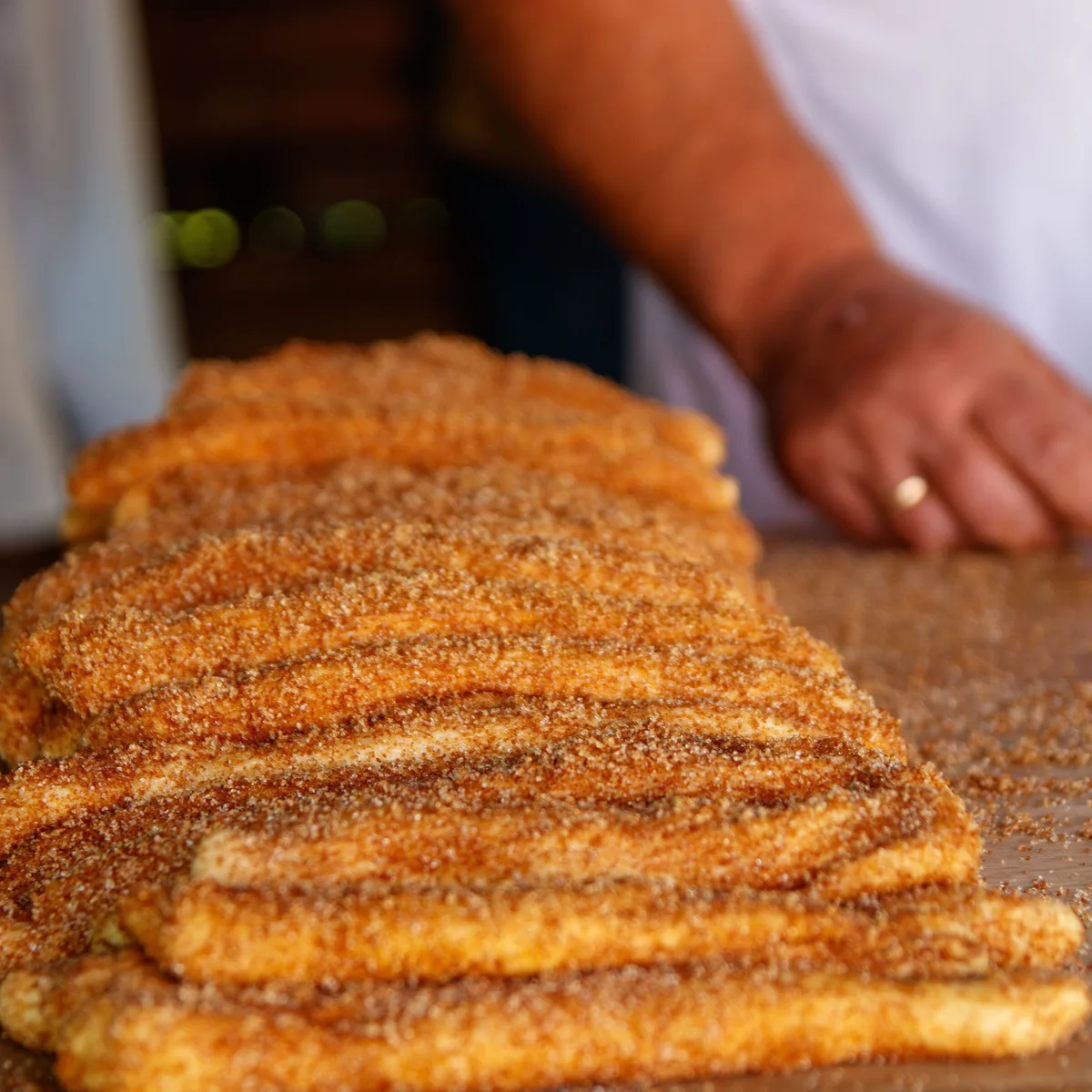
- Lift onto a rack for 30 seconds, then roll each one in the cinnamon sugar while it is still hot and slightly oily, which is what makes the coating stick.
Churros in Mexico and Spain
Churros are Spanish in origin and were carried to Mexico, where they became their own thing. In Spain they are typically thinner, eaten for breakfast, and dipped in thick drinking chocolate. In Mexico they are usually rolled in cinnamon sugar, sold from carts and fairgrounds, and often filled with cajeta, dulce de leche or chocolate. The recipe here is the Mexican cinnamon-sugar version. It is a fair adaptation to call it that rather than the Spanish original, because the cinnamon coating is the Mexican habit.
Why This Recipe Works
- Cooking the flour in boiling liquid is what lets the dough hold its shape. When flour meets boiling water and fat, its starch granules swell and gelatinise, forming a paste stiff enough to stand up when piped. That is the same dough family as choux pastry. Flour simply stirred into warm liquid never gelatinises, and the result slumps off the piping tip and spreads in the oil.
- The ridges let steam out, so the churro does not burst. Inside a frying churro, water is turning to steam while the outside sets into a rigid shell. A smooth tube traps that pressure until it finds a weak point and blows out, sometimes violently. The channels cut by a star tip give the steam a continuous path to the surface along the whole length, so pressure never builds. They also add surface area, which is why a ridged churro is crisper than a round one.
- 350F to 360F is the window in both directions. Cooler, and oil soaks into the dough before the surface sets, which is the greasy, heavy churro. Hotter, and the shell browns and hardens while the centre is still raw batter. Within that window, escaping steam actively keeps oil from penetrating.
Ingredient Notes
The flour. Plain all-purpose. Bread flour makes them chewy rather than tender, because more gluten means a tougher network. Measure it properly: too much flour gives a dough too stiff to pipe, and the fix is another egg rather than water.
The eggs. Two, beaten in one at a time once the dough has cooled for five minutes. Eggs are what give churros their light interior, and they are also the reason the timing matters. Added to hot dough they set into scrambled flecks, and no amount of beating undoes that.
The butter. Four tablespoons, fully melted before the flour goes in. Fat coats the flour proteins and keeps the dough tender rather than bready.
The oil. About an inch in a deep, narrow pan, which is enough to fry them turning once, in a pan no more than a third full so it cannot boil over. A thermometer is worth more here than any other tool.
What the card counts. The oil is counted in full, but almost all of a frying panful stays in the pan rather than on the food. USDA has no entry for what a fried piece actually absorbs, and putting a figure on it would mean estimating, which this site does not do. So read the fat and calorie numbers as the ceiling rather than the plate, and note that the oil dominates them.
The Method, In Short
Boil the water and butter, beat in the flour and cook it out, cool briefly, beat in the eggs, pipe into 350F oil, fry until deep golden, roll in cinnamon sugar while hot. Have the sugar mixed and the rack ready before you start frying, because churros need coating within a minute of leaving the oil.
Reading the dough. Correctly made, it holds a stiff peak on the spoon and a piped line keeps its ridges without spreading. If it runs, it needs a few minutes in the fridge. If it is too stiff to push through the bag, beat in one more egg.
Piping Safely and Neatly
Use a sturdy bag and a large closed star tip, and hold it a few inches above the surface rather than close to it. Cut each length with kitchen scissors as you go. Pipe three or four at a time only; a crowded pan drops the oil temperature sharply, and that is what turns a batch greasy. If you would rather not pipe over hot oil, pipe the lengths onto a lined tray first, chill them for fifteen minutes so they firm up, and lower them in with a slotted spoon.
Fillings and What to Dip Them In
Thick Mexican-style hot chocolate is the traditional dip, and cajeta or dulce de leche is the traditional filling, piped into the end of a cooled churro with a long nozzle. Chocolate ganache and fruit jam both work. Fill churros only once they are completely cool, since warm filling makes the interior steam and the crust soften from the inside. For more sweets in this cuisine, see Mexican dessert recipes.
Storage, and Why They Are a Same-Day Food
Churros are at their best within twenty minutes of frying and they do not keep gracefully. The crisp shell depends on a dry surface, and moisture migrates out of the soft interior into that shell within a couple of hours, which is why yesterday’s churro is leathery. They hold a day in a paper bag at room temperature and re-crisp reasonably in a 375F oven or air fryer for five minutes. Never refrigerate them, which speeds up the staling of the starch. The dough itself keeps two days covered in the fridge, so you can make it ahead and fry to order, which is the better plan for a party.
Why Churros Burst, and How to Tell It Was About To
A burst churro is a pressure failure, and there are two contributors. The first is a smooth surface with no channels, so use a star tip and check that the ridges are actually visible on the piped dough; a worn or too-small tip rounds them off. The second is oil that is too hot, which sets the shell fast and hard before the inside has finished releasing steam. A churro frying in properly heated oil bubbles steadily along its whole length, which is the steam venting as designed. One that sits almost still and then swells in a bulge is building pressure, and that bulge is the warning. Lower the heat between batches; oil climbs in temperature while the pan sits empty.
FAQ
Why did my churros come out greasy? The oil was too cool, so it soaked into the dough before the surface could set. Hold it at 350F to 360F and fry only three or four at a time, since a crowded pan drops the temperature.
Why do churros explode in the oil? Steam pressure with nowhere to go. Pipe with a star tip so the ridges give the steam a path out, and keep the oil in range so the shell does not harden before the inside has finished venting.
Can I make churros without a piping bag? You can spoon short lengths in, but they will be dense and rounded rather than crisp, because the ridges are what create the surface area and the steam channels. A sturdy zip bag with the corner cut and a star tip pushed through works in a pinch.
Can I bake or air fry churros? You can, and they are pleasant, but they are a different thing. Without hot oil the surface dries rather than crisping, so the texture is closer to a ridged breadstick. Brush them with butter and coat them in cinnamon sugar straight out of the oven.
Why is my dough too runny to hold its shape? Either the flour was not cooked long enough in the boiling liquid to gelatinise, or there was too much liquid. Cook the paste for a full minute until it pulls away from the pan, and chill a loose dough for a few minutes before piping.
When do I add the cinnamon sugar? Within a minute of the churro leaving the oil, while the surface is hot and faintly oily, which is what the sugar sticks to. Coated cold, it falls off.
Where to Go Next
The other great Mexican caramel dessert is flan, the milk-soaked classic is tres leches cake, and there is more at Mexican dessert recipes. The whole library starts at easy Mexican recipes at home.
Written by Frank Thomson, Skillet & Spoon editorial. Every nutrition figure on this site is calculated ingredient by ingredient from the USDA FoodData Central database, never estimated and never rounded to look better. We do not publish net-carb figures or use non-nutritive sweeteners. How we develop and source recipes is set out in our editorial policy.