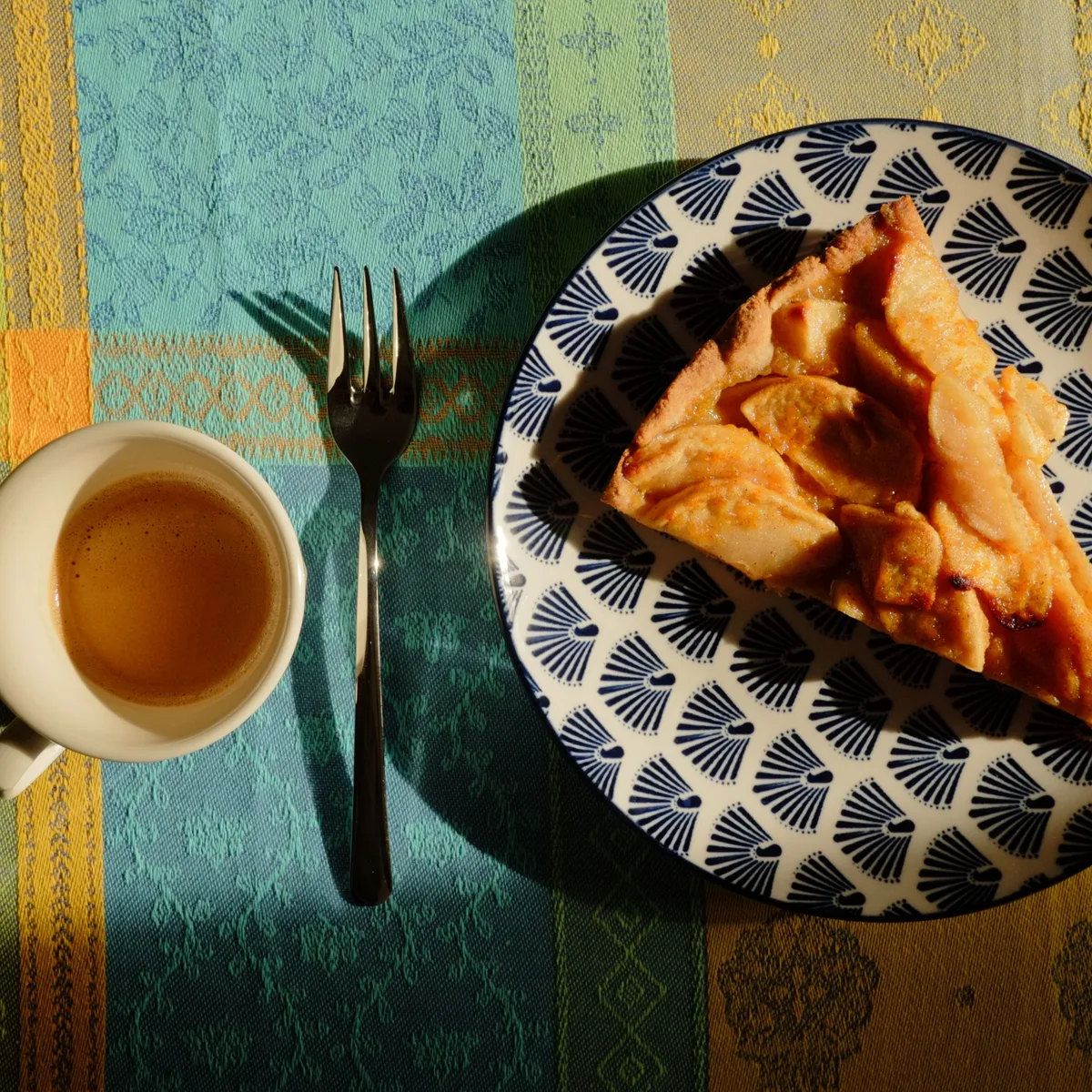
Apple Pie, Flaky Crust and Set Filling
Apple pie is really two problems that meet in one dish: a crust that should be flaky and a filling that should set into neat, sliceable wedges rather than a flood. The crust fails when the fat gets warm; the filling fails when the juice is not thickened or the pie is cut too soon. Keep the butter cold, thicken the apples, and let the pie cool fully, and it comes out the way it should. This classic apple pie is calculated from USDA FoodData Central so the number under each slice is real, and the sweetness is real sugar and the apples’ own, never a substitute.
Ingredients
Method
- {‘Make the crust’: ‘cut the cold cubed butter into the flour and salt until the pieces are pea-sized, add the ice water a tablespoon at a time just until the dough holds, then divide in two, flatten into discs and chill at least an hour.’}
- Toss the sliced apples with both sugars, the cornstarch, cinnamon and lemon juice until evenly coated.
- Roll one disc of dough and line a pie dish, then fill with the apples, mounding them in the centre.
- Roll the second disc, lay it over the top or cut it into strips for a lattice, seal and crimp the edges, and cut vents in a solid top so steam can escape.
- Bake at 400F for about 50 to 55 minutes, until the crust is deep golden and the filling bubbles in the centre, not just at the edges.
- Cool for at least two hours before slicing, so the filling sets rather than running.
The Flaky Crust
Flakiness is cold fat in flat pieces. Cut cold butter into the flour so it stays as small, pea-sized pieces, and in the oven those pieces steam and push the dough into layers, which is the flaky texture. Let the butter warm and it blends into the flour instead, baking short and crumbly rather than layered. Handle the dough as little as possible, because working it builds gluten and toughens the crust, add only enough ice water to just bring it together, and chill the shaped dough so the fat is cold going into the oven.
Stopping a Soggy Bottom and a Runny Filling
Apples give off a lot of juice as they bake, so the filling needs a thickener, here cornstarch, to turn that juice into a glossy, sliceable filling rather than a flood. Cornstarch only thickens once it reaches a boil, so the pie has to bake until the filling bubbles in the centre, not just at the edges, or the starch never fully sets. And a pie cut while hot runs no matter how well it was thickened, because the filling needs to cool and set, which is why the two-hour cool is part of the recipe, not an afterthought.
Choosing the Apples
Firm, tart-sweet apples hold their shape and balance the sugar best, so a baking apple such as Granny Smith, Honeycrisp or a mix keeps some bite rather than collapsing to sauce. Softer eating apples break down more, which some people prefer; a mix of two kinds gives both texture and flavour. Slice them evenly so they cook at the same rate.
Lattice or Solid Top, and Serving
A solid top crust needs vents cut into it so steam escapes, or the filling boils up and splits the seams; a lattice vents itself through its gaps and looks the part with little extra skill, since the strips are simply woven over and under. Brush the top with beaten egg for a glossy, deep-brown finish, and a sprinkle of sugar adds sparkle. The fluted rim browns faster than the centre, so once it has coloured, cover just the rim with a ring of foil and let the rest catch up. Serve apple pie just warm rather than hot, so the filling has set, and a scoop of vanilla ice cream or a pour of cream alongside is the classic finish. Baking the pie on a preheated tray in the lower part of the oven helps crisp the bottom crust.
Storing
Apple pie keeps a day at room temperature, loosely covered, then goes to the fridge, where it keeps a few more days. It reheats well in a low oven, which re-crisps the crust that softens in storage. Baked pie freezes well, and an unbaked assembled pie can be frozen and baked from frozen with extra time, which is a good way to get ahead. Individual slices also freeze and reheat well for a single serving.
FAQ
How do I get a flaky apple pie crust? Keep the butter cold and in pea-sized pieces, add only enough ice water to bring the dough together, handle it as little as possible, and chill the shaped dough before baking. Cold fat steams into flaky layers; warm fat bakes crumbly.
Why is my apple pie filling runny? Either it needed more thickener or it did not bake long enough. Cornstarch only sets once the filling reaches a boil, so bake until it bubbles in the centre, and let the pie cool for a couple of hours so the filling sets.
How do I stop a soggy bottom? Bake the pie low enough and long enough that the base cooks through, and cut vents in a solid top so steam escapes rather than condensing inside. Baking on a preheated tray helps crisp the bottom.
What are the best apples for apple pie? Firm, tart-sweet baking apples such as Granny Smith or Honeycrisp hold their shape, and a mix of two kinds gives both texture and flavour. Very soft eating apples collapse to sauce.
Why did my crust shrink? The dough was stretched into the dish rather than eased in, or it was not chilled, so the gluten and warm fat pulled it back as it baked. Ease the dough in without stretching and chill it before baking.
Can I use a sugar substitute? This recipe does not, because sugar draws juice from the apples and helps the filling set, which substitutes cannot do. It uses real sugar, counted honestly from USDA data.
Where to Go Next
For every pie type and the crust and filling science, see the pie recipes guide, and for baked fruit without the crust, the fruit desserts guide. For the baking behind it all, see dessert recipes.
Written by Frank Thomson, Skillet & Spoon editorial. Every nutrition figure on this site is calculated ingredient by ingredient from the USDA FoodData Central database, never estimated and never rounded to look better. We do not publish net-carb figures or use non-nutritive sweeteners. How we develop and source recipes is set out in our editorial policy.