12 Diabetic Smoothie Recipes Built Vegetable-First
Diabetic smoothie recipes have to reckon with the smoothie’s public reputation, which it earned: the juice-bar model blends fruit into fruit, sweetens the result, and serves what is functionally dessert through a straw. This page rebuilds the format from the other end. Every blend below is vegetable-first: a leafy or mild vegetable base, berries as the fruit voice, Greek yogurt or cottage cheese for protein and body, nut butter or chia for staying power, and unsweetened almond milk as the pour. Nothing is sweetened beyond its own ingredients, and every card counts the full blend from USDA data per this section’s policy.
The template matters more than any single recipe, so it goes first.
The Template: Green, Berry, Protein, Fat, Pour
One from each column, into the blender, in this order for the smoothest result: the pour first (unsweetened almond milk or water), the protein second (Greek yogurt, cottage cheese), the fat third (peanut butter, chia, flaxseed), the fruit fourth (frozen berries, half a banana), the green last on top (spinach, which vanishes; kale, which does not pretend to). Frozen fruit replaces ice entirely, keeping flavor where cubes would water it down. Blend a full sixty seconds, longer than feels necessary; the difference between a smoothie and a gritty shake is patience at the switch.
Every recipe below is a walk through that template, and once it is in your hands, so is every smoothie you will ever improvise.
The Core Dozen
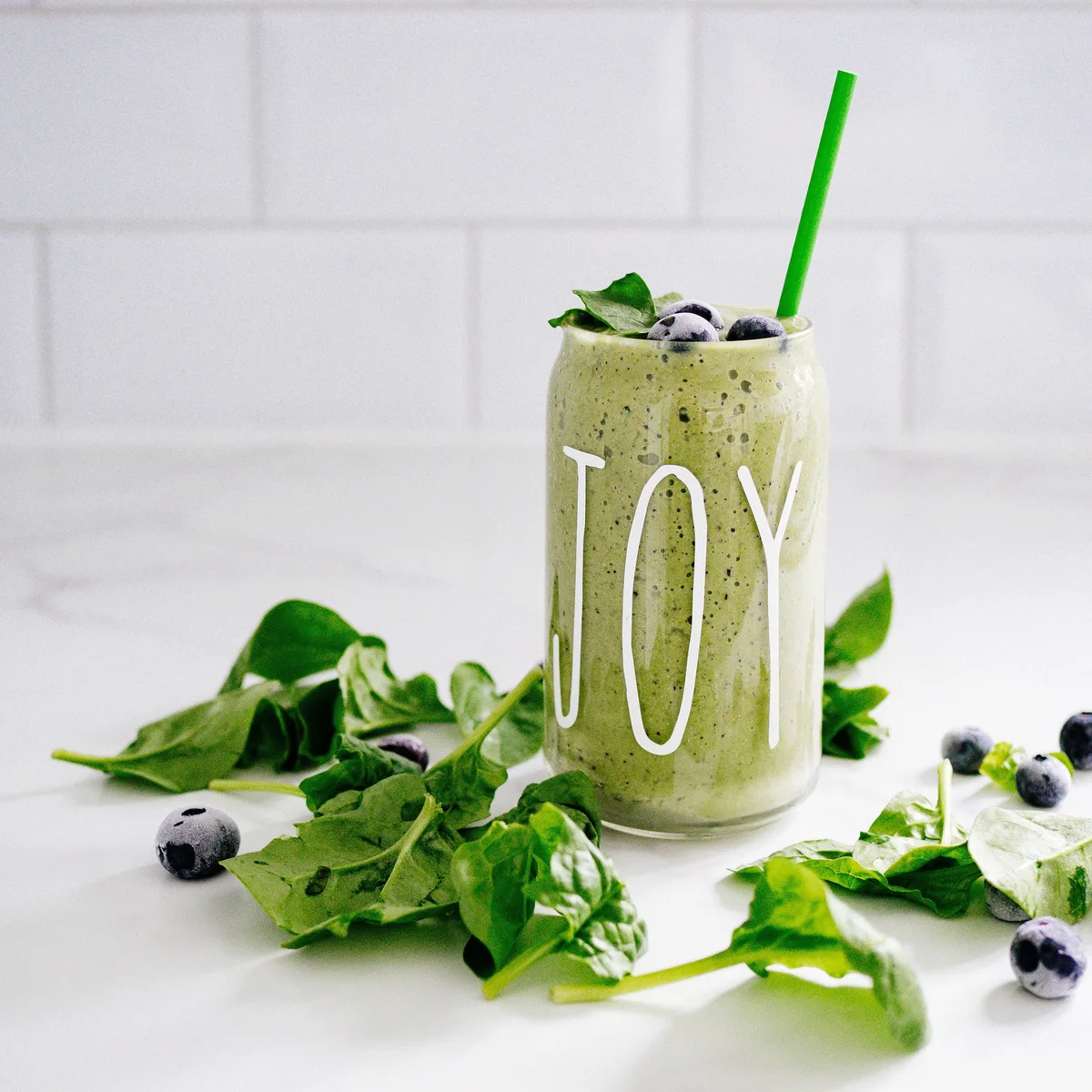
Spinach berry classic. Spinach, mixed frozen berries, Greek yogurt, chia, almond milk. The template’s proof of concept and the one to make first.
Peanut butter banana green. Half a frozen banana, peanut butter, spinach, cottage cheese, almond milk. The one that tastes most like the juice bar and counts nothing like it.
Strawberry cottage cheese. Frozen strawberries, cottage cheese, vanilla, almond milk. Blends into something close to strawberry cheesecake, which the card states in honest grams.
Chocolate peanut butter. Unsweetened cocoa, peanut butter, half a banana, Greek yogurt, almond milk. The dessert-adjacent end of the page, labeled as such.
Blueberry flax. Blueberries, ground flaxseed, Greek yogurt, cinnamon, almond milk. The fiber leader of the dozen.
Raspberry almond. Raspberries, almond butter, spinach, Greek yogurt. Bright, pink, and the lowest-sugar blend here.
Green cucumber cooler. Cucumber, spinach, half a green apple, lime, water base. The lightest glass on the page, summer’s answer.
Pumpkin spice. Canned pumpkin, Greek yogurt, cinnamon and nutmeg, almond milk, a counted teaspoon of maple syrup. October in the template’s clothing.
Cherry vanilla. Frozen cherries, cottage cheese, vanilla, almond milk. Tastes indulgent; reads honest.
Mocha morning. Cold coffee as half the pour, cocoa, Greek yogurt, half a banana. Breakfast and the commute’s coffee in one container.
Tropical green, tamed. Spinach, frozen mango kept to a measured half-cup, cottage cheese, lime, almond milk. The tropical profile with the fruit as accent rather than engine.
Avocado lime. Quarter avocado, spinach, lime, Greek yogurt, water. Silky beyond reason, and the template’s fat column graduating to the lead role.
Why Blending Changes the Math
An honest note that belongs on any smoothie page in this section: blending makes food faster to consume and easier to over-pour, which is exactly why every card here defines its serving as the full recipe, one glass, listed in cups before blending. A smoothie’s numbers are only as honest as its pour, so the cards are written to the glass, not to the pitcher. The chew-some-of-it principle also survives here: the chia and flax blends set slightly as they stand, inviting a spoon, and a smoothie eaten slowly does its holding job better than one raced through a straw. None of this is prescription; it is design honesty about a format that makes overshooting easy, published so your decisions start from the glass as it actually is.
Make-Ahead Logistics
Smoothies are a morning format with a night-before secret: the freezer pack. Portion each recipe’s solid ingredients, berries, banana, spinach, measured nut butter frozen in a dollop, into labeled bags on Sunday; each morning, one bag plus the pour plus sixty seconds equals breakfast. Packs keep three weeks, which makes the dozen above a rotating menu rather than a decision. Blended smoothies themselves keep a day in a sealed jar with a shake to revive, acceptable for the afternoon but honestly second-best; the pack system exists so fresh is never slower than stored.
The spinach note for skeptics: frozen spinach works in every green blend here at half the volume, vanishes even more completely than fresh, and turns the produce drawer’s most frequent casualty into a freezer staple.
How the Numbers Work
Every card counts the complete blend, fruit, nut butter, yogurt and all, from USDA data with source IDs archived, per the editorial policy. No net carbs, no “mostly water” hand-waving. The glass is the serving, and what any glass means for your morning is a decision for you and your care team, made with a card that hid nothing in the blender.
Troubleshooting the Glass
Four failures cover nearly every disappointing smoothie, and each has a template fix. Too thin: the fruit went in fresh instead of frozen, or the pour was generous; hold back a quarter of the liquid and add only if the vortex stalls. Too thick: the chia got ahead of you, since it drinks liquid for ten minutes after blending; either serve immediately or thin the standing glass with a splash and a stir. Bitter or grassy: the green exceeded its ratio, almost always kale ambition, and doubling the berries rescues the batch while the template rescues the next one. Gritty: under-blended, full stop; sixty real seconds, and frozen fruit slightly thawed if the blades are struggling. None of these failures waste ingredients, which is among the format’s quiet virtues; every rescue is a stir or a splash away.
The flavor lever most people never pull: acid. A squeeze of lime brightens the green blends the way it brightens everything else on this site, and a few drops of vanilla extract make the dairy-forward blends taste rounder at zero cost to the card. The finishing rules of the whole kitchen apply at the blender exactly as they do at the stove.
Why Loading Order Beats Motor Power
The template loads liquid first and greens last for a physical reason: the pour sitting at the blades forms the vortex that drags everything else down through them. Load the greens first and the pour last, and there is nothing fluid at the bottom to catch the leaves, so they cling to the walls above the blade line and never get pulled through, whatever the motor rating. Liquid at the blades is what pulls everything else down into the vortex, and no motor rating substitutes for it. It is the cheapest blender upgrade that exists: load in the right order and the machine you own becomes the machine the ads promised.
FAQ
Can smoothies really be part of a diabetic eating pattern? That question belongs to you and your care team, decided with real numbers, which is precisely what each card provides. What we can say is that these blends are built protein-first with fruit as a measured voice, and every gram is counted.
Why no fruit juice as the base? Because the pour is the biggest silent variable in any smoothie, and unsweetened almond milk or water keeps it nearly silent. The fruit in the glass is fruit you can see and count.
Are green smoothies actually palatable? Spinach vanishes behind berries because its leaves are tender and its flavor mild enough for the berries’ color and sweetness to cover it completely; kale never quite does, since its leaves are tougher and its flavor more bitter, which is why the template lists spinach as the default and kale as a choice made with open eyes.
What blender do I need? Any blender that can hold a vortex, loaded in the template’s order. Frozen fruit is harder on cheap motors; letting the pack thaw ten minutes closes most of the gap.
Which one first? The spinach berry classic, because it teaches the template, and the strawberry cottage cheese second, because it converts whoever watched you make the first one.
Where to Go Next
The lighter-glass subset built around the same template lives at diabetic smoothie recipes for weight loss, the rest of the morning lineup at diabetic breakfast recipes, and the section’s foundations at the diabetic recipes pillar.
Written by Frank Thomson, Skillet & Spoon editorial. Every nutrition figure on this site is calculated ingredient by ingredient from the USDA FoodData Central database, never estimated and never rounded to look better. We do not publish net-carb figures or use non-nutritive sweeteners. How we develop and source recipes is set out in our editorial policy.